
Evergreen vs Trending Content: Which Should You Prioritize?
Evergreen or trending content, which should a new blogger prioritize? Here is the honest answer, why it matters most for small sites, and how to balance both.
ANUM SAEED
7/16/20267 min read
Evergreen vs Trending Content: Which Should You Prioritize?
Quick answer: If you are a new blogger or run a small site, prioritize evergreen content. Evergreen content keeps bringing in search traffic for months or years after you publish it, which is exactly what a young site needs to build a steady foundation. Trending content can bring a quick spike of attention, but it fades fast, and chasing trends is where a lot of new bloggers burn out with little to show for it. The ideal long-term mix is mostly evergreen with a little trending on top, but when you are just starting and every hour counts, evergreen is the smarter bet.
If you have ever wondered whether to write the timeless "how to" guide or jump on the topic everyone is talking about this week, this is a genuinely important decision, especially early on. Get it right and your small site builds momentum. Get it wrong and you can spend months producing content that disappears from search within days.
Let me walk through the honest difference, and why the answer is not the same for a big brand as it is for someone just starting out.
What is evergreen content?
Evergreen content is content that stays relevant and useful long after you publish it. The topic does not expire. People search for it this month, next year, and the year after.
Think of guides like "how to start a blog," "how to fix a slow website," or "what is keyword research." Nobody wakes up one day and stops needing that information. The search demand is steady and ongoing.
Evergreen content is slow to take off but keeps paying you back. A single good evergreen post can bring in search traffic month after month with no extra work, which is why it is the backbone of almost every successful blog.
What is trending content?
Trending content is tied to something happening right now, a news event, a new product launch, a viral moment, a seasonal spike. It captures a wave of attention while that wave is cresting.
Think of "reactions to the latest Google update," "thoughts on the newest AI tool that launched this week," or anything tied to a current event. When the topic is hot, these posts can pull in a burst of traffic quickly.
The catch is that the wave passes. Once the moment is over, the searches dry up, and a trending post that was pulling hundreds of visitors a day can go quiet within a week or two.
The honest difference for a small site
Here is where most articles on this topic give generic "it depends" advice. I want to be more direct, because for a new blogger the answer really is not 50/50.
Evergreen content compounds. Trending content spikes and fades.
Picture two new bloggers who start on the same day. Sarah writes a guide called "How to Start a Blog." Ali writes a post called "Google's June 2026 Core Update: What Happened." Both get a bit of attention in their first week.
Six months later, the picture looks completely different. Sarah's guide is still quietly pulling in visitors every day, because people are always starting blogs and always searching for how. Ali's post has gone silent, because the update is old news and nobody is searching for it anymore. Same effort, same starting point, totally different outcome. That is the difference between evergreen and trending in one example.
When you are a big brand with an established site and a team, you can afford to chase trends, because you already have a foundation of evergreen content bringing in steady traffic. Trending content is the extra flourish on top.
When you are a new blogger, you do not have that foundation yet. Every post you write is precious, because you only have so many hours. If you spend those hours chasing trends, you end up with a pile of posts that each brought a brief spike and then went silent, and your traffic never builds. It is a treadmill.
This connects to a hard truth about new sites: a new site takes months to gain traction no matter what you write. Since you are waiting anyway, you want the content you publish during that wait to still be working for you when the traction finally arrives. Evergreen content does that. Trending content is often long dead by then.
Evergreen vs trending at a glance
If you strip it down to the essentials, here is how the two compare:
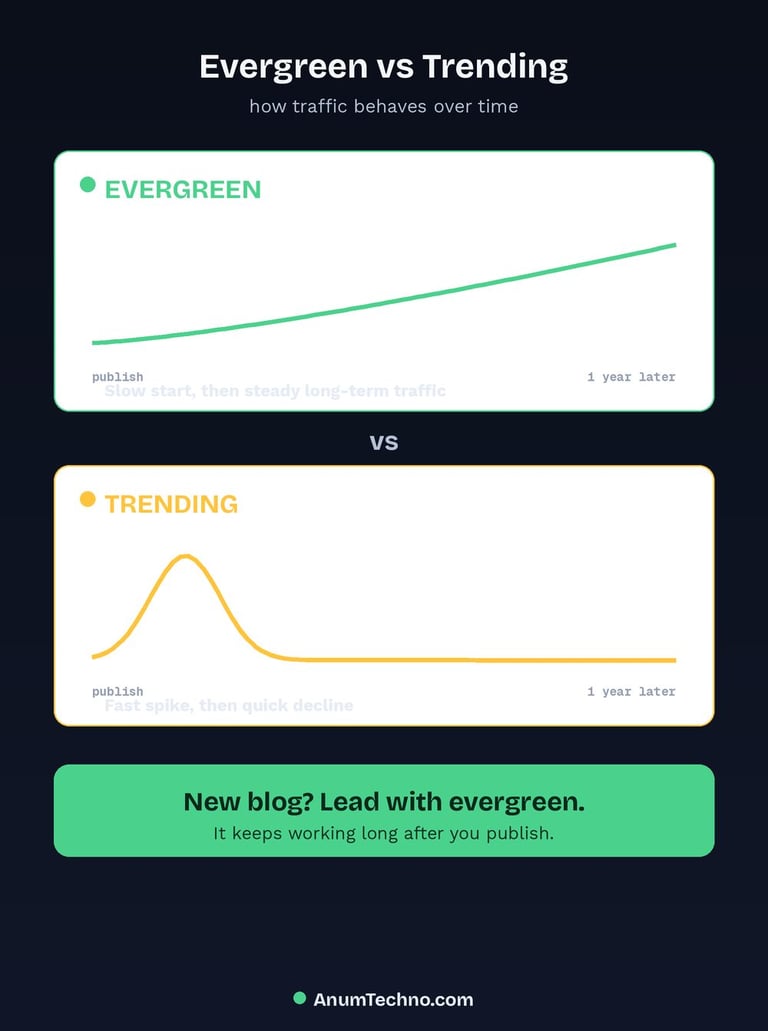
Traffic pattern: evergreen brings long-term, steady traffic. Trending brings a short-term spike.
Speed: evergreen grows slowly. Trending gives fast visibility.
Lifespan: evergreen stays useful for years. Trending becomes outdated quickly.
Upkeep: evergreen is easy to refresh and keep current. Trending is hard to revive once the moment passes.
Best fit: evergreen is best for new and growing blogs. Trending suits established sites with a foundation already in place.
You can see this pattern in how people search, too. Searches for timeless topics like "how to start a blog" stay relatively steady month after month, while searches tied to a news event tend to spike sharply and then fall away within days or weeks. That search behaviour is exactly why evergreen content keeps earning traffic long after trending content has gone quiet.
Why chasing trends burns out new bloggers
This is worth saying plainly, because it is one of the most common ways new bloggers exhaust themselves for nothing.
Trending content demands speed. To catch a trend, you have to publish while it is hot, which means constant pressure to react fast, again and again. Miss the window and the post is worthless. And because trends fade, you can never stop, you are only as relevant as your last trending post, so you are on a permanent hamster wheel.
Meanwhile, building blog traffic takes time and a body of work regardless. So the blogger who spent three months chasing trends and the blogger who spent three months building evergreen guides are in completely different places at the end. One has a pile of dead posts and exhaustion. The other has a growing library that keeps pulling in search traffic.
There is also a traffic-stability angle. A site built heavily on trends is fragile, because when a trend passes, your traffic can suddenly drop and you are left scrambling for the next one. An evergreen foundation is far steadier.
So is trending content ever worth it?
Yes, but with a clear head about why you are doing it.
Trending content has real uses, even for a small site:
Quick visibility. A well-timed trending post can get you noticed faster than evergreen content, which is slow by nature.
Relevance and freshness. Covering current topics shows readers, and search engines, that your site is active and in touch.
Backlink and share potential. Timely content sometimes attracts links and social shares that a timeless guide would not.
Testing a topic. A trend can reveal whether an audience cares about a subject before you invest in a big evergreen piece on it.
The key is to treat trending content as a supplement, not your main strategy. A little trending content on top of a solid evergreen base is healthy. Trending content as your whole plan is a burnout machine.
How to balance the two
Once you have some evergreen foundation built, a simple, sustainable approach works well.
Lead with evergreen. Make the majority of what you publish evergreen, especially in your first several months. This is the content that compounds.
Add trending selectively. When something genuinely relevant to your niche is happening and you can add a real perspective, write about it. Do not force it.
Turn trends into evergreen where you can. Instead of "reactions to this week's update," write "what the latest changes mean for X," in a way that stays useful after the news fades. You capture some of the timely traffic and keep some long-term value.
Update your evergreen posts. Evergreen does not mean untouched. Refreshing your timeless guides keeps them accurate and competitive, and often gives them a ranking boost.
A common rule of thumb is roughly 70 percent evergreen and 30 percent trending once your site is established. For a brand-new blog, I would lean even harder toward evergreen, closer to 80 or 90 percent, until you have a foundation to build on.
Frequently Asked Questions
Should a new blogger write evergreen or trending content? Mostly evergreen. A new blog needs a foundation of content that keeps bringing in search traffic over time, and evergreen content does exactly that. Trending content fades quickly, so relying on it early means constantly starting over. Focus on evergreen first, and add trending posts occasionally when something genuinely relevant to your niche comes up.
Is evergreen content better than trending content? Neither is universally better, they serve different purposes. Evergreen content builds steady, long-term traffic and is ideal for small and growing sites. Trending content creates short bursts of visibility and works best as a supplement once you already have an evergreen foundation. For most new bloggers, evergreen delivers far more value per hour spent.
What is the ideal mix of evergreen and trending content? For an established site, a common guideline is around 70 percent evergreen and 30 percent trending. For a brand-new blog, lean even harder toward evergreen, closer to 80 to 90 percent, until you have built a foundation of content that is bringing in steady traffic. Then you can add more trending content on top.
Does trending content help SEO? It can, in short bursts. Trending content can attract quick traffic, social shares, and sometimes backlinks while the topic is hot. But those benefits fade as the trend passes. Evergreen content tends to help SEO more sustainably, because it keeps earning traffic and links over a long period rather than spiking and disappearing.
Can trending content become evergreen? Sometimes, with the right angle. Instead of writing a purely time-bound reaction, frame the piece around what the trend means in a lasting way. For example, rather than "reactions to this week's news," write a guide on the underlying topic that stays useful after the news fades. That way you capture some timely traffic and keep long-term value.
Final Word
If you are running a small or new site, the honest answer is clear: prioritize evergreen content. It is the foundation that keeps working for you long after you hit publish, and it is what turns scattered effort into steady, compounding traffic.
Trending content is not the enemy, it has real uses, and a little of it on top of a strong evergreen base keeps your site fresh and relevant. But do not build your whole strategy on chasing waves that always pass.
So here is the one decision that matters most: if you are publishing your next blog post this week, choose a topic that someone will still be searching for a year from now. That single choice, made over and over, will do more for your site's long-term growth than any trend you could chase. Build the foundation first, and let it compound.
Contact
Subscribe our Newsletter
© 2026. All rights reserved.
about anumtechno
AnumTechno is a modern digital platform focused on AI, SEO, and content creation insights. The website helps creators, bloggers, and marketers learn how to use artificial intelligence to write better content, improve search rankings, and grow online traffic effectively. It shares practical guides, tutorials, and strategies designed to simplify complex SEO and AI concepts for beginners and professionals alike.