
How to Prove You Didn't Use AI (Even If You're Accused)
Falsely accused of using AI on work you actually wrote? Here's how to prove it's yours, using version history, drafts, and research that hold up.
AI TOOLS FOR STUDENTS
ANUM SAEED
6/19/20267 min read
Quick answer: If your work was wrongly flagged as AI, don't try to argue with the detector score. Prove your innocence by showing your writing process instead: your document's version history, your messy early drafts, your research notes and sources, and your willingness to explain your work in person. Detectors produce false positives all the time, so concrete evidence of how you built your work is far stronger than any percentage a tool spits out.
AI detector false positive: A situation where an AI detection tool incorrectly labels human-written content as AI-generated. False positives are common, which is why a detector score should never be treated as proof on its own.
If you've been accused of using AI on work you wrote yourself, you already know how unfair it feels. You did the research. You wrote the words. And now you're being asked to prove your own honesty, as if the effort never happened. Students often assume their submission platform caught them. In reality, Canvas has no AI detection of its own, and knowing what actually flagged you changes how you respond.
It's a situation more and more students and writers are finding themselves in. The accusation usually sounds the same: a teacher or reviewer runs your work through an AI detector, it spits out a high "AI" score, and suddenly you're defending work you genuinely did. The frustrating part is that you know the truth, but a tool has cast doubt on it.
So this guide is about exactly that: how to prove you didn't use AI when you genuinely didn't, using evidence that actually holds up.
How to Prove You Didn't Use AI (Quick Summary)
Show your document's version history
Keep your rough drafts and outlines
Save your research notes and sources
Be ready to explain your work in person
Point out that AI detectors produce false positives
Here's how each of these works, and how to actually use them if you're accused.
Why Honest Work Gets Flagged in the First Place
Here's the part that makes this so unfair. AI detectors don't actually "detect AI." They can't see who wrote something. They measure patterns, mainly how predictable your words are and how much your sentence length varies, and then make a probability guess.
The problem is that clean, well-structured, formal writing, exactly what school trains you to produce, often looks "predictable" to these tools. So the better and more polished your writing is, the more likely it gets flagged. It's completely backwards, but that's how the math works. (I explained this in more detail in why AI detectors flag your writing.)
This is also far worse for non-native English speakers, whose natural writing tends to be simpler and more predictable. So a flag is not proof of anything. It's a guess, and often a wrong one.(This same bias affects students applying to university, which I covered in do colleges use AI detectors for applications.)
1. Show Your Writing Process (Your Strongest Proof)
The single most powerful way to prove your work is yours is to show how it was built over time.
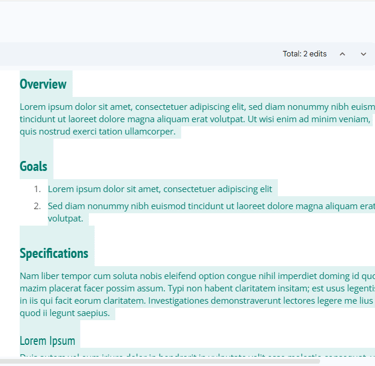
If you wrote in Google Docs or Microsoft Word, you have version history. It records your document growing bit by bit, with timestamps, edits, deletions, and rewrites. This matters because AI-generated work appears all at once, fully formed. Real human work shows messy, gradual progress, sentences added and removed, paragraphs reordered, ideas that changed halfway through.Version history shows less than most people assume, and it flags plenty of honest students. I went through exactly what it records and what it cannot prove in can teachers see your Google Docs edit history.
Pull up that version history (in Google Docs it's under File, then Version history) and you can show a reviewer the entire evolution of your work. It is very hard to fake, and it's the closest thing to undeniable proof that you wrote something yourself.
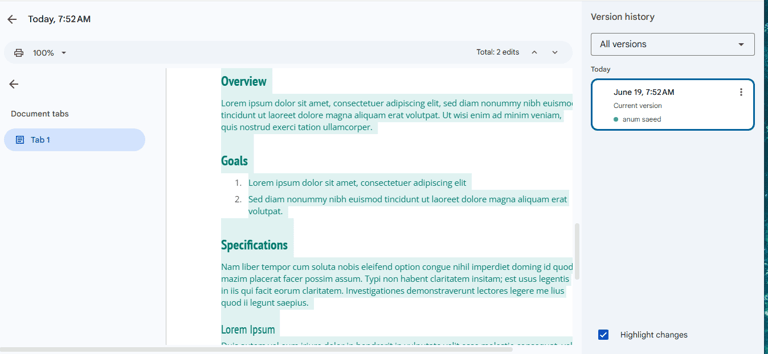
If you don't already do this, start writing everything important in a tool that keeps version history. It's the best insurance you have.
2. Keep Your Drafts and Rough Notes
Your messy early work is evidence, not embarrassment.
Those half-finished outlines, scribbled brainstorms, abandoned paragraphs, and rough notes all prove you developed the ideas yourself. The messier and more incomplete they are, the better, because AI doesn't produce messy drafts. It produces clean, finished text instantly.
So don't delete your early versions. Keep the document where you dumped your first thoughts, the outline you reshaped three times, the paragraph you cut. That trail of imperfect, human progress is exactly what a reviewer needs to see.
3. Show Your Research Trail
One of the most convincing things you can point to is the actual research behind your work.
You can keep the sources you used, your browser history from when you were researching, the articles and PDFs you read, the library databases you searched, and any notes you took along the way. This proves you genuinely gathered the information yourself.
This is especially powerful because AI often invents fake sources, citations, and statistics that look real but don't exist. So when you can show real, verifiable sources you actually read and used, that's strong evidence a human did the work.
4. Can AI Detectors Be Wrong? (Point Out That They Are)
Yes, AI detectors are wrong often, and you're allowed to push back on the tool itself, calmly and with facts.
AI detectors are known to produce false positives, flagging genuine human writing as AI. A Stanford study found that detectors wrongly flagged around 61% of essays by non-native English speakers, even though they were entirely human-written. Several major universities have stepped back from these tools over accuracy concerns, and even OpenAI shut down its own AI detector because it wasn't reliable enough.
So you can respectfully explain that a detector score is not proof. It's an unreliable probability guess, and no fair decision should rest on it alone. (If you want to understand how the different tools compare, I covered that in which AI detector is closest to Turnitin.)
5. Be Ready to Explain Your Work
This is the simplest and often most convincing proof of all.
If you genuinely wrote something, you understand it. You can explain why you made certain arguments, why you rejected others, what your sources said, and how your thinking developed. Someone who used AI usually can't do this, because they didn't actually build the ideas.
So offer to sit down with your teacher or reviewer and talk through your work. Walk them through your thesis, your reasoning, your choices. Being able to discuss your own work in depth, confidently and in your own words, is something no AI-generated submission can fake.(It's also one of the main ways teachers tell if you used ChatGPT, so it works both ways.)
How to Protect Yourself Before It Ever Happens
The best defense is the one you set up before you're ever accused.
Write important work in Google Docs or Word with version history on, so your process is always recorded. Keep your drafts, notes, and sources instead of deleting them. And if you use AI at all, keep it to brainstorming or checking grammar, not writing your actual content, and be honest about it where your school's policy requires.
None of this is about proving a negative under pressure. It's about quietly keeping the evidence that shows your work is yours, so if the moment ever comes, you're ready.
One more practical thing: know your rights. Most schools have a written academic integrity policy that explains how accusations are handled and what process you're entitled to. If you're accused, it's completely reasonable to calmly ask for a formal review rather than accepting a decision made on a detector score alone. Reading that policy before you ever need it means you'll know exactly what to ask for.
Your AI Accusation Response Checklist
If you've just been accused, here's a calm, step-by-step list of what to do:
Don't panic or get defensive. Stay calm and ask for the specific reason and evidence behind the accusation.
Pull up your document's version history (Google Docs or Word) and save or screenshot it.
Gather your drafts, outlines, and rough notes that show your work developing.
Collect your research trail: sources, browser history, annotated PDFs, and notes.
Find earlier work you've submitted, so you can show your writing style is consistent.
Calmly note that AI detectors produce false positives and aren't proof on their own.
Offer to explain your work in person and answer questions about it.
Check your institution's academic integrity policy and ask about a formal review process if needed.
The Bottom Line
Being accused of using AI when you didn't is genuinely awful. Many students and writers describe it as deeply frustrating, because they know they did the work, yet a detector score suddenly puts that work into question. But the way through isn't arguing about a detector percentage. It's showing the human story behind your work: the version history, the messy drafts, the real research, and your own clear understanding of what you wrote.
Detectors guess. Your process proves. Hold on to the evidence of how you actually work, and you'll always have something far stronger than any score a machine can produce.
Frequently Asked Questions
How do I prove I didn't use AI? Show your writing process: your document's version history, early drafts, and research notes, and offer to explain your work in person. This evidence is far stronger than arguing about a detector score.
Is version history enough to prove I wrote something myself? It's the single strongest piece of evidence, because it shows your document growing gradually over time with timestamps, something AI-generated work doesn't have. Combined with your drafts and research, it's very convincing.
Can I be falsely accused even if I wrote everything myself? Yes. AI detectors produce false positives often, especially for clean, formal writing and for non-native English speakers. A flag is a guess, not proof.
What should I do the moment I'm accused? Stay calm, gather your version history, drafts, and sources, and offer to discuss your work with the reviewer. Point out, respectfully, that AI detectors are known to be unreliable.
How can I protect myself in advance? Write in Google Docs or Word with version history enabled, keep your drafts and research notes, and limit any AI use to brainstorming or grammar rather than writing your content.
Can teachers fail you based only on an AI detector? No. AI detectors are not proof of misconduct. Most schools require human review and additional evidence before taking disciplinary action. A detector score should be treated as one signal, not a final verdict.
Sources
Liang et al. (2023), Patterns (Cell Press) — Stanford study on AI detectors' bias against non-native English writers.
Public statements from universities (including Vanderbilt) on disabling Turnitin's AI detector over accuracy concerns.
OpenAI — announcement discontinuing its own AI classifier due to low reliability.
Contact
Subscribe our Newsletter
© 2026. All rights reserved.
about anumtechno
AnumTechno is a modern digital platform focused on AI, SEO, and content creation insights. The website helps creators, bloggers, and marketers learn how to use artificial intelligence to write better content, improve search rankings, and grow online traffic effectively. It shares practical guides, tutorials, and strategies designed to simplify complex SEO and AI concepts for beginners and professionals alike.