
How to Rank on Google AI Overviews in 2026
Want your content cited in Google AI Overviews? This 2026 guide covers what actually gets you featured, based on real testing, not recycled theory.
SEO TOOLSBLOGGINGAI TOOLS
ANUM SAEED
5/24/202612 min read
Search Intent Analysis
Primary intent: Informational — bloggers, SEO professionals, and website owners want to understand how to appear in AI Overview results Hidden intent: Frustration — many people are losing clicks to AI Overviews and want to either appear in them or understand how to survive them Emotional intent: Anxiety about declining organic traffic, desire to stay relevant Trust signals expected: Real examples, tested strategies, honest perspective on what works and what doesn't
There is a specific kind of frustration that comes with watching your Google Search Console impressions rise while your clicks stay flat.
You are ranking. People are searching. But something is absorbing the attention before they reach your result.
That something is Google AI Overviews — the AI-generated summaries that now appear at the top of millions of search results, pulling answers directly from web content and displaying them without requiring a click.AI Overviews are only one part of how AI is changing search. To see the complete picture, read my guide on SEO vs AEO vs GEO and how the three work together.
For some bloggers and content creators, AI Overviews have become the enemy. For others, they have become an opportunity. The difference between those two experiences usually comes down to one thing: whether your content gets cited inside the Overview or gets passed over entirely.
This guide covers what actually determines that outcome — not the theoretical SEO advice that has been circulating since AI Overviews launched, but the practical patterns that emerge when you pay close attention to what Google is actually selecting and why.
Quick Answer — How to Rank on Google AI Overviews in 2026
To rank in Google AI Overviews in 2026, content needs clear direct answers, strong heading structure, FAQ sections, topical authority, and demonstrated expertise. Google favors pages that answer questions quickly, structure information clearly, and provide practical depth beyond generic SEO advice.
The main ranking factors at a glance:
Direct answer placed in first two to three paragraphs
Clear H2 and H3 heading hierarchy
FAQ section with specific extractable answers
Article and FAQ schema markup
Demonstrated experience and specific examples
Strong topical authority through internal linking
PageSpeed score above 80 on mobile
What Google AI Overviews Actually Are — and Why They Matter
Google AI Overviews are AI-generated responses that appear at the top of certain search results. They synthesize information from multiple web sources, display it in a conversational format, and include citations — small source links that direct users to the pages Google pulled from.
Those citations are what every content creator should be focused on. If you are still building the content foundation that makes citations meaningful, understanding how to make money blogging for beginners in 2026 covers why topical authority matters long before monetization becomes relevant. Getting cited in an AI Overview is not the same as ranking number one in traditional results, but in many ways it is more visible. The Overview appears before any organic result. Users see it first. And if your site is cited, your brand name appears alongside Google's summary — a trust signal that traditional rankings do not provide in the same way.
The question most people ask is: how do I get my content cited?
The honest answer is that Google has not published a definitive technical specification for what makes content AI Overview eligible. What does exist is observable pattern — the types of content that appear repeatedly in Overviews across different topics share specific characteristics that are identifiable and reproducible.
Content Type vs AI Overview Citation Likelihood
AI Overview Optimization Checklist
Before publishing any article you want cited in AI Overviews, run through this checklist:
Direct answer appears within first three paragraphs or Quick Answer box
H1 is clear and matches search intent exactly
H2 and H3 headings are specific and question-style where relevant
FAQ section included with at least 4 to 6 specific questions
Each FAQ answer is self-contained and extractable
Article schema added with author name and dates
FAQPage schema added for FAQ section
PageSpeed score above 80 on mobile
Internal links to related topical articles
At least one specific data point or real observation per major section
No generic filler paragraphs — every section answers something specific
This is the same principle behind why Claude vs ChatGPT for beginner bloggers consistently outperforms generic AI tool comparisons — specific, experience-driven content with clear structure gets cited while generic overviews do not.
Why Most Content Gets Passed Over
Before getting into what works, it helps to understand what consistently fails.
The majority of content that gets overlooked by AI Overviews falls into a few predictable categories. Generic articles that cover a topic broadly without committing to specific, verifiable positions. Content that answers the surface question but leaves the follow-up questions unanswered. Pages with weak structure — long walls of text without clear headings, no FAQ sections, no direct statements that can be extracted cleanly.
There is also a pattern worth understanding around credibility signals. AI Overviews pull heavily from pages that demonstrate genuine expertise — not just pages that claim expertise. A page that says "we are experts in SEO" is less likely to be cited than a page that demonstrates SEO knowledge through specific, accurate, and verifiable information.
The practical implication is that optimizing for AI Overviews is less about technical tricks and more about being genuinely worth citing.
The Content Characteristics That Get Cited
AI Overviews prioritize content that answers questions clearly enough to be extracted without additional context.
Direct, Specific Answers Placed Early
The most consistently cited content structures place a direct answer to the primary question within the first two to three paragraphs or within a clearly labeled summary section near the top of the page.
Google's system appears to prioritize content that can be extracted cleanly — statements that answer a specific question completely in one or two sentences, without requiring the reader to piece together an answer from surrounding context.
This does not mean dumbing down the content. It means being deliberate about where the clearest, most extractable answers live. If someone asks "how long does AdSense approval take" and your article buries the answer in paragraph twelve after extensive preamble, Google will likely source that answer from a page that leads with it.
The pattern that works: state the direct answer early, then provide the context, nuance, and depth that makes the answer genuinely useful.
Structured Heading Hierarchy
AI Overviews pull from content that is structurally clear. Proper heading hierarchy — H1 for the page title, H2 for major sections, H3 for subsections — signals to Google's systems that the content is organized around specific answerable topics rather than being a single undifferentiated block of text.
Each H2 or H3 heading is effectively a potential citation target. A heading like "How to Apply for Google AdSense in 2026" followed by a specific, complete answer to that question is a natural extraction candidate. A heading like "More Information About AdSense" followed by vague discussion is not.
This means heading writing is not just about organization — it is about creating discrete, answerable units of content that can stand alone as citation targets.
FAQ Sections With Specific Questions
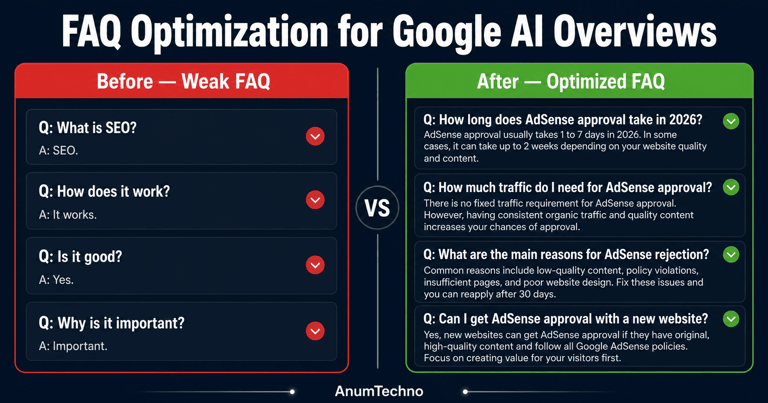
FAQ sections have become one of the most reliable citation sources in AI Overviews. The format maps directly to how AI systems process information — a clear question followed by a direct, complete answer.
The most effective FAQ questions are the ones people actually type into Google, not the ones that sound good in a content brief. "How much traffic do I need for AdSense approval" will outperform "What are the requirements for AdSense" because it matches the specificity of real search queries.
Each FAQ answer should be self-contained — answerable without reading the rest of the article. This is the extraction test: if you read only the question and answer in isolation, does it make complete sense? If yes, it is a strong AI Overview candidate. If the answer requires surrounding context to make sense, it needs to be revised.
Demonstrated Experience and Specific Examples
There is a meaningful difference between content that explains a concept and content that demonstrates practical experience with it.
Explaining what Google AI Overviews are is informational. Describing specifically how a particular page structure change affected citation frequency is experiential. The second type of content consistently performs better in AI Overview selection because it contains the kind of specific, verifiable detail that generic articles cannot replicate.
For a blog about AI tools and SEO, this means weaving in specific observations from running AnumTechno.com — actual PageSpeed scores, actual Search Console data, actual outcomes from specific decisions. This is not padding. It is the material that makes content credibly citable rather than generically informational.
Practical Implementation — What to Do Right Now
Audit Your Existing Articles for Extraction Readiness
Go through each published article and ask a simple question: can I find a direct, complete answer to the article's main topic within the first three paragraphs or a clearly labeled quick answer section?
If the answer is buried in the middle of a long article, move it. Add a "Quick Answer" or "Summary" box near the top. This single change makes the content significantly more citation-ready without requiring a full rewrite.
For anyone still building their content foundation from scratch, our guide on how to start a blog in Pakistan and make money in 2026 covers the exact setup steps before AI Overview optimization becomes relevant.
Add or Improve FAQ Sections
Every article covering an informational topic should have a FAQ section. The questions should be sourced from Google's "People Also Ask" results for the primary keyword — these are the questions Google has already identified as related to the search intent, which means they are the questions AI Overviews are likely to address.
Write answers that are specific, complete, and between two and five sentences. Too short and they lack the completeness that builds credibility. Too long and they lose the extractability that makes them useful citation candidates.
Strengthen Your Heading Structure
Review the heading structure of each article. Every H2 and H3 should be phrased as a specific topic or question, not a vague category label. "How Long Does AdSense Approval Take in 2026" is a strong heading. "Timeline Information" is not.
After each heading, the first paragraph should directly address whatever the heading promises. If the heading asks a question, the first sentence of the section should answer it.
Build Topical Authority Through Internal Linking
AI Overviews pull more frequently from pages that exist within a topically authoritative context. A single strong article on a topic is less likely to be cited than a strong article that sits within a cluster of related content — where the site has demonstrated consistent expertise across multiple related topics.
Internal linking connects this cluster. When your article on Google AI Overviews links to your article on Google AI Content Policy, which links to your article on How to Use AI for SEO, Google's systems recognize the topical coherence. This is part of what distinguishes a genuine expert resource from a single isolated article on a topic.
The Technical Side — What Actually Matters
Technical quality signals do not override content quality — but they contribute to the overall credibility assessment that determines citation priority.
Page Speed and Core Web Vitals
Pages that load slowly are less likely to be cited, not because of a direct algorithmic penalty but because Google's crawling systems prioritize content from pages that demonstrate technical health. A page scoring 40 on PageSpeed mobile is a signal that the site is not being maintained with the attention to quality that Google's systems are designed to reward.
If your articles are still scoring below 80 on PageSpeed, our complete breakdown of how to use AI content for SEO without getting penalized covers the technical and content quality standards Google evaluates together.
Getting your article pages to score 80 or above on PageSpeed is worthwhile — not as a magic citation trigger, but as part of the overall quality signal that makes a page a credible source.
Structured Data
Schema markup does not directly determine AI Overview citations. But it does help Google's systems understand what your content is about, which increases the probability of it being surfaced for relevant queries.
FAQPage schema, Article schema with proper author and date information, and HowTo schema for instructional content all contribute to this understanding. The investment is modest and the signal benefit is real.
HTTPS and Security
This is table stakes at this point but worth confirming. Content from pages with security issues or HTTPS errors is rarely cited in AI Overviews. If your site has any mixed content warnings or certificate issues, resolving them should be the first technical priority.
What Nobody Tells You About AI Overviews and Clicks
Here is the part most content about AI Overviews gets wrong.
The common framing is that AI Overviews are purely negative for organic traffic — that they absorb clicks that would otherwise go to your article. This is true in some cases. For very simple informational queries where Google can provide a complete answer in a few sentences, people may not click through.
But for more complex queries — the kind that require practical guidance, nuanced explanation, or implementation detail — AI Overview citations often drive additional clicks rather than replacing them. Users read the Overview, find a source that looks authoritative and detailed, and click through to read more.
The implication is that the content most worth optimizing for AI Overview citation is not the content that answers simple questions. It is the content that demonstrates enough practical depth that a user who sees your site cited would reasonably want to read more.
This is another reason why experience-driven, specific, deeply practical content consistently outperforms generic overviews — even in an AI Overview context.
The Honest Reality About Citation Timing
Getting cited in AI Overviews is not immediate. New content typically needs three to six months to accumulate the signals that make it a reliable citation candidate — indexing, crawling patterns, link signals, engagement data.
This is worth stating clearly because there is no shortcut. The strategies described in this article are not about gaming an algorithm. They are about producing content that is genuinely worth citing — specific, accurate, practically useful, and clearly structured.
Content that meets those criteria gets found. It gets cited. And unlike many SEO tactics that work until an algorithm update removes them, content that is genuinely useful tends to remain useful as Google's systems become more sophisticated, not less.
Common Mistakes to Avoid
Optimizing for citation without improving quality. Adding FAQ sections and adjusting heading structure improves citation probability only when the underlying content is worth citing. Structural optimization layered on top of thin content produces thin content with better structure.
Targeting AI Overview citations for highly competitive head terms. The realistic opportunity for most blogs is in the long-tail — specific, detailed questions where Google has not already established dominant citation sources. Competing for AI Overview citations on "what is SEO" is a different challenge from competing for "how to fix a robots.txt error in Cloudflare."
Confusing AI Overviews with featured snippets. These are related but distinct features. Featured snippets pull a single passage from a single page. AI Overviews synthesize multiple sources. The optimization strategies overlap but are not identical.
Ignoring the citation link itself. When your page is cited in an AI Overview, the citation appears as a small source link. Users who are interested enough to read the Overview may click those links. This means your page title, your brand name, and the first words visible in the citation matter for click-through. A clear, specific page title that matches what the Overview is discussing will outperform a generic or clever title that does not clearly signal what the page covers.
Connecting AI Overview Strategy to Broader SEO
Optimizing for AI Overviews is not a separate discipline from SEO. It is SEO with slightly different emphasis.
The core principles are identical: produce content that genuinely helps real people, structure it clearly, demonstrate expertise through specificity rather than assertion, and build topical authority through consistent coverage of related topics.
The specific tactical differences — emphasis on extractable answers, FAQ structure, heading precision — are extensions of existing best practices rather than departures from them.
For anyone building a blog in the AI tools or SEO niche, this means the same effort that improves traditional rankings also improves AI Overview citation probability. There is no separate AI Overview strategy to layer on top of existing work. There is only the work of making content as genuinely useful and clearly structured as possible — and making sure that usefulness is findable within the first few paragraphs.
For a complete understanding of how Google evaluates AI-assisted content alongside these considerations, our guide on Google AI Content Policy Explained 2026 covers the specific standards Google applies when evaluating whether content — AI-assisted or otherwise — meets its quality thresholds.
And if you are still building the traffic foundation that makes AI Overview citations meaningful, our guide on best free keyword research tools for US SEO traffic covers the workflow for finding the specific long-tail queries where citation opportunities are most accessible for newer sites.
Frequently Asked Questions
Does having FAQ schema guarantee an AI Overview citation? No. FAQ schema helps Google understand your content structure but does not guarantee citation. The quality, specificity, and accuracy of the content itself is the primary factor. Schema is a supporting signal, not a trigger.
How long does it take to appear in AI Overviews after publishing? Most pages that eventually get cited begin appearing in AI Overviews between three and six months after publishing, once Google has had time to crawl, index, and evaluate the content across multiple ranking signals. There is no reliable shortcut to this timeline.
Should I create content specifically for AI Overviews or optimize existing content? Both approaches work. Optimizing existing content — particularly improving FAQ sections, heading structure, and early answer placement — is often the faster path to citation. New content built with these principles from the start tends to accumulate signals more efficiently over time.
Does AI Overview citation reduce organic clicks? For simple queries with complete answers, sometimes yes. For complex practical queries, citations often drive additional clicks from users who want more detail than the Overview provides. The net effect depends heavily on the topic and the depth of the content.
What types of content are most likely to be cited? Practical guides, how-to content, FAQ-structured articles, and content with specific verifiable information consistently outperform generic overviews in citation frequency. Content that answers follow-up questions within the same article is particularly well suited to AI Overview selection.
Can a new blog with low domain authority get cited? Yes — particularly for specific, low-competition queries where no established authoritative source has produced strong content. Domain authority matters less for AI Overview citations than content quality and structural clarity, especially for niche or long-tail topics.
Key Takeaways
Appearing in Google AI Overviews comes down to producing content that is genuinely worth citing — specific, accurately structured, and useful enough that a user who sees the citation would reasonably want to read more. Direct answers placed early, strong FAQ sections with specific questions, precise heading structure, and demonstrated practical expertise are the consistent factors across content that gets cited regularly. Schema markup and technical page quality support the signal but do not substitute for content quality. The timeline to citation is measured in months, not days — there is no shortcut, but there is a clear and reproducible path.
Conclusion
The bloggers and SEO professionals doing well with Google AI Overviews in 2026 are not the ones who found a technical trick for getting cited. They are the ones who took the shift as confirmation that the content quality fundamentals have always been correct.
Specific answers. Clear structure. Real expertise. Content that helps people accomplish something rather than content that exists to fill a keyword slot.
That has always been what Google claims to want. AI Overviews have simply made it more visible when a page delivers on that promise and when it does not.
Build content worth citing and the citations follow. That is the entire strategy.
For more practical guides on SEO, AI tools, and building a blog that actually generates results, visit AnumTechno.com.
Contact
Subscribe our Newsletter
© 2026. All rights reserved.
about anumtechno
AnumTechno is a modern digital platform focused on AI, SEO, and content creation insights. The website helps creators, bloggers, and marketers learn how to use artificial intelligence to write better content, improve search rankings, and grow online traffic effectively. It shares practical guides, tutorials, and strategies designed to simplify complex SEO and AI concepts for beginners and professionals alike.