
Indexed But Not Ranking on Google? The Real Reasons Your New Blog Is Invisible (2026)
Quick answer: If your pages are indexed but not ranking, it is almost always one of three things: your site is too new and still in Google's trust-building phase, you are targeting keywords that are either too competitive or have no real search volume, or your content is thin and has no internal links pointing to it. Zero impressions usually means a brand-new site or zero-volume keywords. Impressions but no clicks means you are ranking, just too low to be seen. I will show you how to tell which one is your problem and exactly what to do about it.
I remember the exact feeling. I would open Google Search Console five times a day, stare at a tiny trickle of impressions, and wonder if my whole site was broken.
AnumTechno was indexed. I checked. The pages were in Google. The impressions were not zero, but they were small and erratic, a few one day, almost none the next, with the occasional spike that vanished as fast as it came. And clicks? Basically none for a long time. It felt like shouting into an empty room and getting a random echo back every now and then, never anything steady.
If that is where you are right now, take a breath. Your site is probably not broken. I have been through this exact stage, on a site I built on an expired domain with a messy history, and I grew it out of the dead zone by hand. So this is not theory pulled off a listicle. This is what actually happens and what actually works.
Let me walk you through it.
What My First Three Months Actually Looked Like
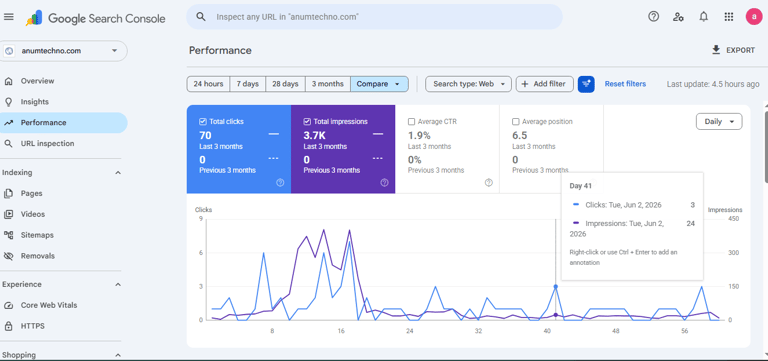
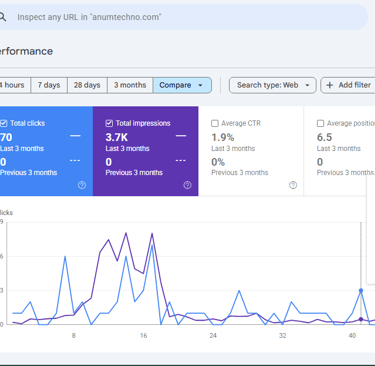
That graph is not a stock image. It is my own Search Console from the first three months of AnumTechno, and I am showing it precisely because it is messy and real, not a clean, fairy-tale curve.
Here is what actually happened. It did not grow in a smooth line. There were a couple of early spikes where a page caught a little attention, then it dropped back to almost nothing, then it bounced around with random peaks for weeks. Some days I got a burst of impressions; the next day, close to nothing. It felt chaotic and discouraging while I was living it.
But step back and look at the whole stretch, and the trend is real:
First few weeks: a trickle, then a couple of surprise spikes, then back down. Easy to misread as failure.
The messy middle: irregular peaks and quiet days. This is the part where it feels like nothing is working, even though the foundations are taking hold.
By the end of three months: about 3.7K impressions, 70 clicks, and an average position around 6.5. Not life-changing money, but proof the site had climbed off the floor and was being shown for real searches.
That is the honest shape of a new site finding its feet. Not a straight line up. Spikes, dips, and a slowly rising floor underneath the noise. If your graph looks chaotic, that is not a sign you are failing. It is what early traction actually looks like.
First, Figure Out Which Problem You Actually Have
People lump these together, but "indexed but not ranking" and "zero impressions" are two different situations with different fixes. Sort yourself into one before you do anything.Sometimes the issue is not ranking at all but a sudden change in your data. If your numbers fell overnight, here is why your Search Console impressions can drop suddenly and how to tell normal from a real problem.
Open Google Search Console, go to the Performance report, and look at your impressions for the last 28 days.
Zero impressions. Your pages are indexed, but Google is not showing them to anyone for any search. This is common for brand-new sites and for pages targeting keywords nobody searches.
Some impressions, no clicks. You are ranking, but too low to be seen. You are sitting on page 2, 3, or deeper, so people never scroll to you.
Impressions and a few clicks, but no growth. You are on the board but stuck. This is usually an authority and optimization problem.
Knowing your bucket saves you from fixing the wrong thing. Now let me go through the real reasons, starting with the most common.If your pages are indexed but you are wondering whether the problem is simply that you have not published enough yet, I covered how many posts you actually need before traffic starts and why the number matters less than you think.
Why Your Blog Is Indexed But Not Ranking (The Real Reasons)
1. Your Site Is Simply Too New
This is the hardest one to accept because the fix is patience, not action.
Google does not trust a new website right away. It will index your pages, then hold them back while it figures out whether your site is legit and worth showing. People call it the sandbox. Whatever you call it, it is real, and it mostly affects new domains.If you are watching your positions bounce around, that is normal for a young site. Here is how often Google actually updates rankings for new websites and why they jump around so much at first.
During this phase you can do everything right and still see almost nothing. That is normal. It does not mean your work is wasted. It means the clock has not run out yet.
For me, the first real movement on impressions did not show up until somewhere in the third to fourth month, and only on the pages targeting easy, low-competition phrases. Everything else stayed flat far longer.
What to do: keep publishing, keep building internal links, and stop refreshing GSC every hour. I know that is hard. I checked mine obsessively, and it changed nothing except my stress levels.
2. You Are Targeting Keywords That Are Too Competitive
If you wrote an article targeting a keyword where the entire first page is owned by big, high-authority sites, your page is probably indexed and ranking on page 6 where nobody looks. That reads as zero impressions even though technically you "rank."
A brand-new blog cannot outrank an established authority site on a competitive term, no matter how good the article is. Not yet.
I learned this the slow way. When I checked the first page for the AI study keywords I was chasing, the top results were Reddit threads, university domains, and research sites, with the occasional Quora answer mixed in. There was no room for a young blog in that lineup. My own pages were indexed and technically "ranking," just sitting on page six where impressions are basically zero. The content was fine. The SERP was simply not winnable for a new site yet.Before you target any keyword, check that you can actually win it. The right free keyword research tools show you search volume and competition so you are not chasing terms a new site cannot rank for.
What to do: go after long-tail keywords with low difficulty and, more importantly, a beatable first page. An easy difficulty score means nothing if Reddit, big media, or government sites own page one. Open the actual search results and look at who is ranking. If you see small, low-authority sites on page one, that is your opening. If you see only giants, skip it for now.
3. You Are Targeting Keywords With No Search Volume
This one is sneaky, and it is the reason behind a lot of zero-impression pages.
You can rank number one and still get zero impressions if nobody searches that phrase. It happens when you target a keyword that is just too specific, or when you accidentally optimize for the exact long title of your article, which almost no one types into Google.
What to do: make sure every article targets a phrase that real people search. Aim for a keyword with genuine volume, then write around it. A free keyword research tool will tell you whether anyone actually searches your phrase. If your target shows no search volume, the page can be perfect and still stay invisible.
4. Your Content Is Thin or Lacks Depth
Google has plenty of content to choose from. If yours is short, surface-level, or says the same thing ten other pages already say better, there is no reason to rank it.
This is not about word count for its own sake. It is about actually answering the question more completely and more honestly than the pages currently ranking.
What to do: look at what is ranking for your keyword, then make yours genuinely more useful. Add the detail, the real example, and the step they skipped. First-hand experience is the thing AI cannot fake and the thing Google increasingly rewards.
5. Your Pages Have No Internal Links (Orphan Pages)
When a page has no other pages linking to it, Google sees it as unimportant and may barely crawl it. New bloggers do this constantly. They publish a post and never link to it from anywhere else.
What to do: link every new article from at least two or three other relevant pages on your site, using descriptive anchor text. This passes authority around and tells Google your pages matter. When I went back and added internal links across my orphaned posts and fixed the broken ones, it was one of the few changes where I could actually see crawling and impressions respond afterward. It was a bigger needle-mover than any single new article I published.
6. A Hidden Technical Problem
Sometimes it really is a setting. An accidental noindex tag, a wrong canonical pointing somewhere else, or a robots rule blocking crawlers can quietly keep a page from ranking even after it shows as indexed.
What to do: in Search Console, use the URL Inspection tool on a page that is not ranking. It will tell you if the page is indexable, if Google can crawl it, and whether the canonical is pointing where you expect. If you bought an expired domain like I did, also check that you have not inherited toxic backlinks dragging you down, and disavow them if you have.
How to Fix Zero Impressions in Google Search Console, Step by Step
If your problem is specifically zero impressions, run this checklist in order. This is the exact path I would follow today.
Confirm the page is really indexed. Search site:yourdomain.com/your-page-url in Google. If it shows up, it is indexed. If not, request indexing in the URL inspection tool.
Check that the page is not set to noindex. Use URL Inspection and look for "indexing allowed." A stray noindex is a silent killer.
Check your target keyword has real search volume. If the phrase has no volume, that alone explains zero impressions. Pick a keyword people actually search.
Check where you actually rank. Search your keyword in an incognito window. If you are on page 5 or beyond, you are not getting impressions because almost nobody scrolls that far.
Strengthen the page. Add internal links pointing to it, improve the content depth, and make sure the title and headings match what people search.
Give it time, then watch the trend. After fixes, impressions usually creep up before clicks do. Watch the direction, not the daily number.
Most zero-impression cases come down to one of two things: the site is too new, or the keyword has no volume. Rule those two out first.Even once you are indexed and showing up, you might get impressions without clicks. Here is what causes impressions but no clicks and how to earn the click.
How Long Does SEO Take for a New Website in 2026?
This is the question underneath all the others, so let me answer it straight.
For a brand-new website, expect roughly 3 to 6 months before you see meaningful impressions, and closer to 6 to 12 months before you see real, steady traffic. Some niches move faster; competitive ones move slower.If you are stuck in that quiet early stretch right now, I broke down why a new website is not ranking after months and what is normal versus what is not, in a separate guide.
That timeline assumes you are publishing useful content consistently, building internal links, and targeting keywords you can actually win. If you are targeting terms that are too competitive, the clock basically never starts.
My own site started showing life in that 3 to 6 month window, and only after I fixed the boring foundational stuff: internal linking, killing duplicate-intent pages, and going after winnable keywords instead of dream keywords. The patience is real, but so is the payoff.
If you want to speed it up, the highest-leverage moves are publishing in tight topic clusters, earning a few genuine backlinks, and optimizing pages that already get impressions so they climb from page 2 to page 1. And once that traffic does start arriving, it helps to know the AdSense approval requirements ahead of time so you are ready to monetize it.
The Mistake That Keeps New Blogs Invisible
I want to call out one specific trap because it quietly wrecks new sites: publishing several near-identical articles on the same topic.
When you have three posts all targeting basically the same keyword, Google does not know which to rank, so it splits the signal and often ranks none of them well. This is called keyword cannibalization, and it is one of the most common reasons a blog stays stuck despite lots of content.
If you have done this, pick the strongest page, fold the others into it, and redirect the weaker URLs to the winner. One strong page beats three weak ones every time. Understanding this, along with the difference between SEO, AEO and GEO, changed how I plan content completely.
Frequently Asked Questions
Why is my website indexed but not ranking on Google? Usually because the site is too new and still building trust, the keywords are too competitive for a new domain, or the page is thin and has no internal links pointing to it. Confirm the page is indexed, check your real ranking position in an incognito search, and make sure your keyword has actual search volume.
Why is my blog getting zero impressions in Search Console? Zero impressions almost always means one of two things: your site is brand new and Google has not started showing it yet, or you are targeting a keyword that nobody searches. A perfectly optimized page ranking number one for a zero-volume phrase still gets zero impressions.
How do I fix 0 impressions in Google Search Console? Confirm the page is indexed with a site search, make sure it is not set to noindex, check that your target keyword has real search volume, see where you actually rank in an incognito search, then add internal links and improve depth. Most cases are new-site delay or zero-volume keywords.
How long does it take for a new website to rank on Google in 2026? Plan for 3 to 6 months to see meaningful impressions and 6 to 12 months for steady traffic, assuming you publish useful content consistently and target keywords you can realistically win.
Is it bad that my pages are indexed but get no traffic? Not necessarily. For a new site it is the normal first stage. Indexing is step one. Ranking and traffic come later, once Google trusts the site and you target keywords you can win.
Can I speed up ranking for a new blog? Yes, somewhat. Publish in topic clusters, build internal links, earn a few real backlinks, and optimize pages that already get impressions so they move from page 2 to page 1. There is no way to skip the trust period entirely.
Final Word
If your site is indexed but not ranking, you are not failing. You are at the stage almost every new blogger hits and most quit during. The difference between the sites that break through and the ones that die is rarely talent. It is whether someone keeps fixing the boring foundations while the trust period runs its course.
I stared at that jumpy, going-nowhere impressions line convinced my site was broken, and it turned out I just needed winnable keywords, real internal links, and enough patience to let the noise settle into real numbers. So before you tear your whole site down, ask yourself: have you actually given Google a page it can rank, for a keyword someone is really searching?
Indexed But Not Ranking on Google? Real Reasons + Fix 2026
Indexed but not ranking on Google, or stuck at zero impressions? Here are the real reasons your new blog is invisible, and the exact steps that fixed mine.
SEO & BLOGGINGMAKE MONEY ONLINE
ANUM SAEED
6/23/202610 min read
Contact
Subscribe our Newsletter
© 2026. All rights reserved.
about anumtechno
AnumTechno is a modern digital platform focused on AI, SEO, and content creation insights. The website helps creators, bloggers, and marketers learn how to use artificial intelligence to write better content, improve search rankings, and grow online traffic effectively. It shares practical guides, tutorials, and strategies designed to simplify complex SEO and AI concepts for beginners and professionals alike.