
How Long to Rank Without Backlinks? My Real 4-Month Data
I ranked at position 6.8 with no backlinks in 4 months. The real problem was not ranking, it was getting clicks. Here is my actual Search Console data
SEO & BLOGGING
anum saeed
7/25/20268 min read
How Long Does It Take to Rank Without Backlinks? My Real Data After 4 Months
Quick answer
You can rank without backlinks faster than most people say, but ranking is not the part that pays. My site hit an average position of 6.8 in Google after about four months with zero link building, which is page one on average. The problem was not getting ranked. It was getting clicked. I had thousands of impressions and a click-through rate of just 2.1%, and most of what was holding me back had nothing to do with links: a duplicate homepage, two of my own articles fighting each other, a leftover file from the previous owner, and pages targeting questions that Google now answers itself. This is exactly what happened, with the real numbers.
One thing you need to know before you read the rest of this: my site was not a clean slate.
I bought an expired domain. It came with 28 toxic linking domains already pointing at it, left over from whatever the previous owner did. They were bad enough that I submitted a disavow file to tell Google to ignore them. Since then I have built no backlinks at all. No guest posts, no outreach, no directories, nothing.
So this is not a pure "brand new domain, never touched" test. It is more honest than that, and honestly more common. Most people buying their first domain end up with something that has a little history, good or bad. I am telling you this up front because if I hid it, any SEO reading would spot the gap straight away, and the whole point of this article is that I am showing you the real thing.
Here is what four months actually looked like.
The short version of what I found
Most articles about ranking without backlinks are written by people selling link building services or authority tools, so the conclusion is always the same: you need links, and here is how to get them.
My data says something different, and it surprised me.
Ranking was not hard. Across everything, my average position settled at 6.8. That is page one, on average, with no links.
Getting the click was hard. And the reasons had nothing to do with backlinks.
The numbers after roughly four months
Here is where the site landed, pulled straight from Google Search Console over about three months of search data.
Total clicks: 88
Total impressions: 4,170
Average CTR: 2.1%
Average position: 6.8
Published pages: 25
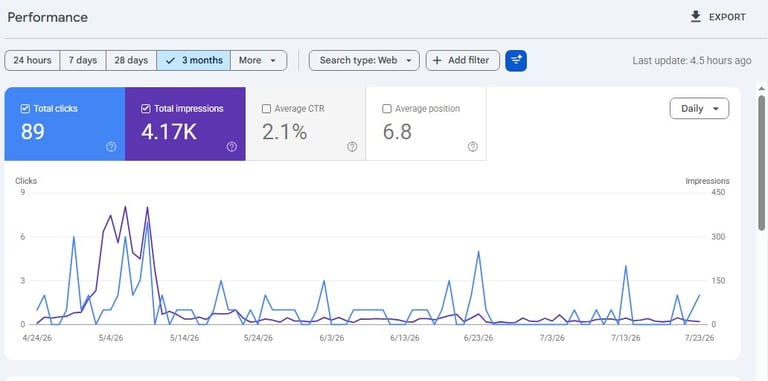
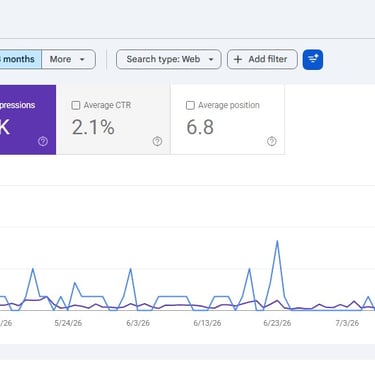
Read those two middle numbers together, because that is the whole story. (I dug into this exact problem separately in why you get impressions but no clicks in Search Console An average position of 6.8 is genuinely fine for a site with no links. A CTR of 2.1% at that position is not. At a real average position of around 7, you would normally expect a higher share of those impressions to turn into clicks.
So I had the rankings. I was leaving the clicks on the table.
Why ranking without backlinks was the easy part
I did not do anything clever to rank. I want to be clear about that, because it is the opposite of what most guides imply.
What I actually did was ordinary:
I went after low competition, specific topics. Not "best AI tools", which is a war. More specific, longer questions where the big sites had not bothered to write a dedicated page. On a new site with no authority, a specific question you can fully answer beats a broad one you cannot rank for.
I wrote genuinely useful pages. Real answers, not padding, and where I used AI to help I did it carefully (I covered that in how to use AI content for SEO without getting penalized. When someone lands and the page actually solves their problem, they stay, and that is a signal Google can read even without links pointing at you.
I linked my own pages together. Every article pointed to the related ones on my site. Internal links are the one kind of link you fully control, and they pass context to Google about what each page is about. This is underrated, and it is free.
That is it. No secret. And it got me to page one on average. Which is exactly why the CTR problem was such a surprise, and why the rest of this article is about that instead.
What was actually holding me back
When I stopped looking at "why am I not ranking" and started looking at "why am I ranking but not getting clicks", I found four things. None of them were about backlinks. All of them were fixable.
1. My homepage was indexed twice
Google had two versions of my homepage in its index, the www version and the non-www version, ranking as if they were separate pages. Between them they were splitting my clicks and impressions.
That is one page competing against itself. Every bit of strength that should have gone to one URL was being divided across two.
The fix: pick one version, force the other to redirect to it, and make sure http always goes to https. One canonical home for the homepage, not two or four.
2. Two of my own articles were fighting each other
I had written two articles on nearly the same topic. (I later wrote up the fix in full: how to find and fix keyword cannibalization Google could not tell which one to rank, so it kept swapping between them and neither one built up properly. This is called keyword cannibalization, and the irony is not lost on me that I did the thing everyone warns about.
The fix: I merged them. Kept the cleaner URL, moved the useful parts of the second article into it, and redirected the old one. One strong page beats two weak ones splitting the same traffic.
3. The previous owner's file was still on my domain
Because I bought an expired domain, some old files came with it. One of them, a PDF manual for a piece of hardware that has nothing to do with my site, was still sitting there and still being indexed by Google as part of my content.
It is a small thing, but it tells Google your site is about something it is not.
The fix: remove leftover files, and check what else is lingering by searching your own domain in Google. On an expired domain especially, do this early. You inherit the previous owner's mess unless you clear it.
4. My biggest page by impressions was barely getting clicked
One article, my Google AI content policy guide, was pulling a huge share of my total impressions and almost no clicks. A tiny CTR on a page Google was showing constantly
There are only three reasons that happens: the page ranks too low to get clicks, the title is not compelling enough to earn the click, or Google is answering the question itself at the top of the results so nobody needs to click through.
The lesson: ranking and traffic are not the same thing
This is the part I wish someone had told me at the start.
Everybody obsesses over ranking. Position one, page one, where am I. But a ranking is only worth something if it turns into a click, and a click is only worth something if the visitor gets what they came for.
I had the rankings. What I was missing was the boring, unglamorous layer underneath: clean URLs, no duplicate pages, titles that make someone want to click, and topics where the click is actually available rather than being eaten by an AI answer.
None of that is link building. All of it is fixable in an afternoon. And for a new site, it is very likely worth more than the backlinks everyone tells you to chase.
So how long does it really take to rank without backlinks?
Here is my honest answer, based on my own site rather than a general rule.
Getting indexed and showing up: a few weeks. My pages started picking up impressions within the first month. If yours are not, that is a different problem: indexed but not ranking on Google.
Reaching a decent average position: a few months. By around four months I was averaging position 6.8 with no links, on specific low competition topics.
Getting meaningful traffic: longer, and it depends far more on the four things above than on how long you wait. I had the rankings well before I had the traffic, because the traffic was being lost to fixable problems, not to a lack of authority.
If you are targeting competitive head terms, backlinks matter and this timeline does not apply. On specific, low competition questions, a new site can reach page one in a few months with no links at all. Whether that turns into traffic is a separate question, and it is the one most people forget to ask.
What I would tell someone starting today
Go specific, not broad. A question you can fully answer beats a topic you can only half-cover. The long tail is where a new site actually wins.
Fix your site before you chase links. Duplicate URLs, cannibalization and messy indexing quietly cost you traffic you already earned. Sort those first. They are free and they are fast.
If you bought an expired domain, audit it. Check the backlinks it came with, disavow the toxic ones if there is a real problem, and clear out any leftover files. You inherit the previous owner's history whether you want it or not.
Watch CTR, not just position. A page ranking at position 7 with a 1% CTR is telling you something. Either the title is weak or the click is being taken by an AI Overview. Both are worth knowing.
Do not believe anyone who promises a fixed timeline. Mine is one site, one niche, roughly four months. Yours will differ. What holds up is the shape of it: ranking comes first and is easier than you think, traffic comes later and depends on details nobody talks about.
FAQ
Can you rank on Google without backlinks? Yes. My site reached an average position of 6.8 with no link building at all, on specific low competition topics. Backlinks still matter for competitive head terms, but for long tail questions a new site can reach page one without them.
How long does it take to rank without backlinks? In my case, pages started getting impressions within the first month and reached a solid average position by around four months. Getting actual clicks took longer, and depended more on fixing site issues than on waiting.
Do you need backlinks to rank a new website? Not for everything. For low competition, specific queries, no. For competitive terms that established sites already dominate, backlinks are usually still needed. Match your targets to what a new site can realistically win.
Why am I getting impressions but no clicks? Common causes are a low ranking position, a title that does not stand out, or an AI Overview answering the query above your result. Check your average position for the page first, then look at the title, then check whether Google is answering it directly.
Does buying an expired domain help you rank faster? It can, but it is a gamble. Mine came with 28 toxic linking domains I had to disavow and leftover files I had to clean up. Any history you inherit can help or hurt, and you do not get to choose which until after you own it.
Is internal linking enough to rank without backlinks? Internal linking will not replace backlinks on competitive terms, but on low competition topics it genuinely helps, because it passes context between your pages and it is the one type of link you fully control.
Related reading
If you are working through the same early-site problems, these go deeper on the pieces I only touched on here:
Final word
Ranking without backlinks is not the hard part. My site proved that at position 6.8 with nothing pointing at it.
The hard part is everything after the ranking: clean URLs, no pages competing with themselves, titles worth clicking, and topics where the click has not already been taken. Fix those and you keep the traffic you earned. Chase backlinks while those stay broken and you are pouring water into a leaking bucket.
I will update this article as the site gets older, because four months is a snapshot, not a conclusion.
Contact
Subscribe our Newsletter
© 2026. All rights reserved.
about anumtechno
AnumTechno is a modern digital platform focused on AI, SEO, and content creation insights. The website helps creators, bloggers, and marketers learn how to use artificial intelligence to write better content, improve search rankings, and grow online traffic effectively. It shares practical guides, tutorials, and strategies designed to simplify complex SEO and AI concepts for beginners and professionals alike.